
This is yet another Application Note of Exar found in- "Applications Data Book" June 1981. The Seven Scanned Pages as attachments can be viewed and studied at …
The availability of low cost dual or quad operational amplifier IC's have made the operational amplifier based active filter techniques cost effective over conventional passive filters. The recent availability of programmable quad operational amplifiers such as the XR-4202 or the XR-346 have provided the active filter designer with the flexibility to externally program gain-bandwidth product, supply current, input bias current, input offset current, input noise and the slew rate.
Application Note - AN-03 - Active Filter Design with IC Op-Amps
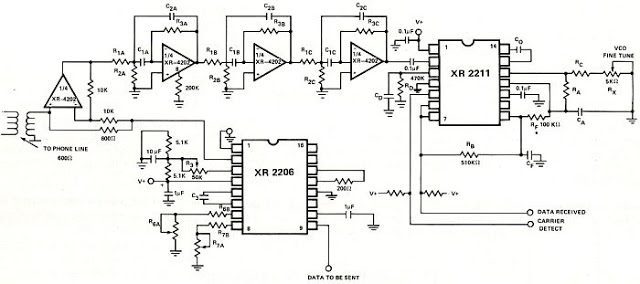
This application note is intended to familiarize the filter designer with the fundamentals of active filter design, using monolithic IC op amps. It presents a table of transfer functions and network equations for high-pass, low-pass, band-pass and band-reject filters. Several design examples are given to illustrate the respective merits and limitations of various filter configurations. Particular emphasis is given to applications of programmable quad operational amplifiers, such as the XR-4202, as an active filter element in FSK Modems.
The availability of low cost dual or quad operational amplifier IC's have made the operational amplifier based active filter techniques cost effective over conventional passive filters. The recent availability of programmable quad operational amplifiers such as the XR-4202 or the XR-346 have provided the active filter designer with the flexibility to externally program gain-bandwidth product, supply current, input bias current, input offset current, input noise and the slew rate.
Application Note - AN-03 - Active Filter Design with IC Op-Amps
This application note is intended to familiarize the filter designer with the fundamentals of active filter design, using monolithic IC op amps. It presents a table of transfer functions and network equations for high-pass, low-pass, band-pass and band-reject filters. Several design examples are given to illustrate the respective merits and limitations of various filter configurations. Particular emphasis is given to applications of programmable quad operational amplifiers, such as the XR-4202, as an active filter element in FSK Modems.